Structured text
Item type for Step 2 CS Patient Note - developed in accordance with the USMLE Step 2 CS Patient Note format -, imitating the medical record composed after a doctor-patient encounter at a clinic, office, or emergency department.

Columns can be added, and the maximum number of rows can also be determined - by default, it is 3.
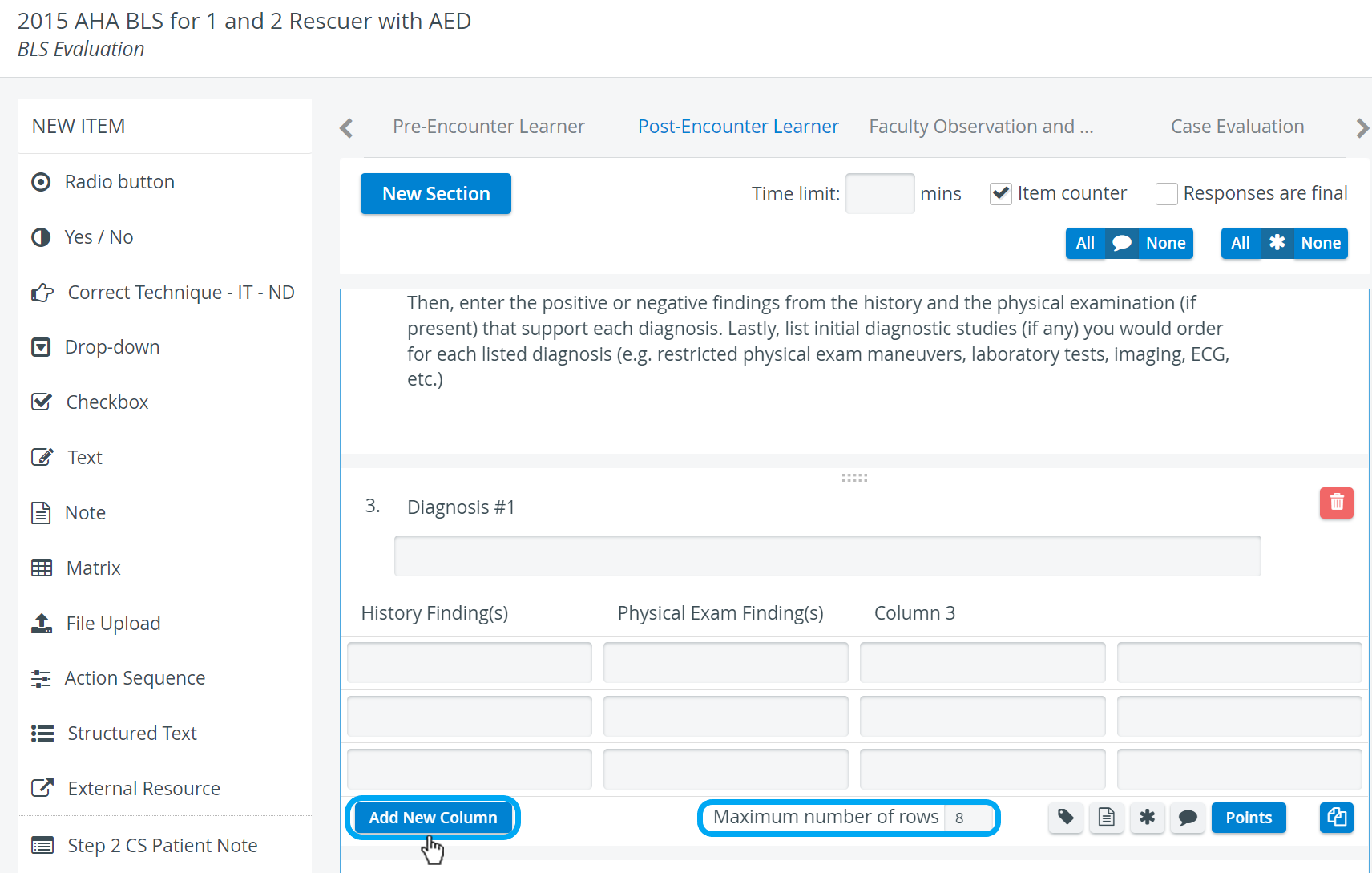
Use the buttons in the item panel for further options:

 Reported comment item - if activated, the item (question) and the answer will be displayed in the Comments Report of the Preset Reports in the Reports module.
The Comments Report displays comments if:
The Reported comment item icon is selected for that particular item in the Case Manager
Comments are entered into the Comments field during the Open-Ended Question Scoring process.


As with any added item, a copied one can be freely modified as desired.
Scoring
Scoring notes provide scoring instructions and are displayed to the OEQS user during evaluation.
Scoring textual items has three available techniques. When clicking the Points button, a drop-down menu appears for selecting the scoring method:
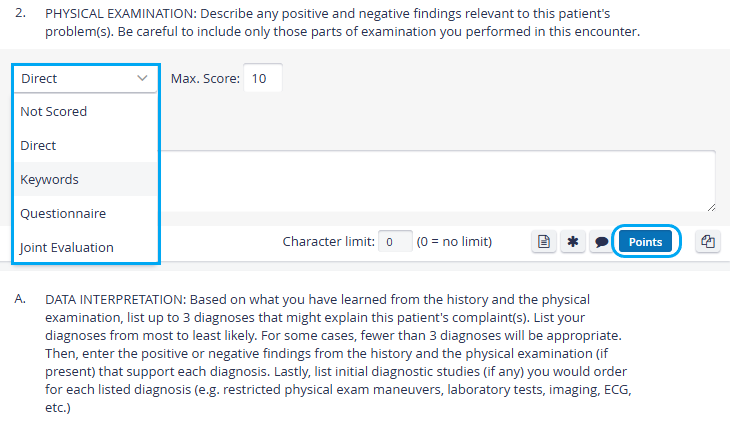
Direct - when direct scoring is selected, a Max. Score field is displayed where the maximum point value has to be determined; OEQS users can choose to give any number between zero and the provided score value.
Keywords - selecting the Keywords method prompts the Set Keywords button to be displayed. Clicking the button opens the Keywords Setup pop-up, where any word can be set with a fixed value thus, when typed in, the system recognizes and calculates a recommended score for the response (from the sum of the point value of the matching words), which is displayed on the OEQS page by highlighting the relevant words in the response text and also listing them with their values and the recommended score.

IMPORTANT: Setting up keywords should be treated as a guideline for scoring; answers should be double-checked and approved by OEQS users.
If multiple spellings are considered acceptable or typos might be disregarded, alternative spellings can be listed within the same keyword field, separated by comma(s). In such a case, the system will calculate the recommended score for either of the listed words.
Questionnaire - Evaluation completed by answering a set of questions. The questionnaire can be created in the Special Section and then selected via the drop-down menus that appear when the Questionnaire method is selected.
Joint Evaluation - Joint evaluation option is available for text and structured text items in the Pre-encounter and Post-encounter parts of a case.
A joint‑evaluation item always relies on a main item that uses a questionnaire scoring method.
One or more joint‑evaluation items can be linked to a main item simultaneously.
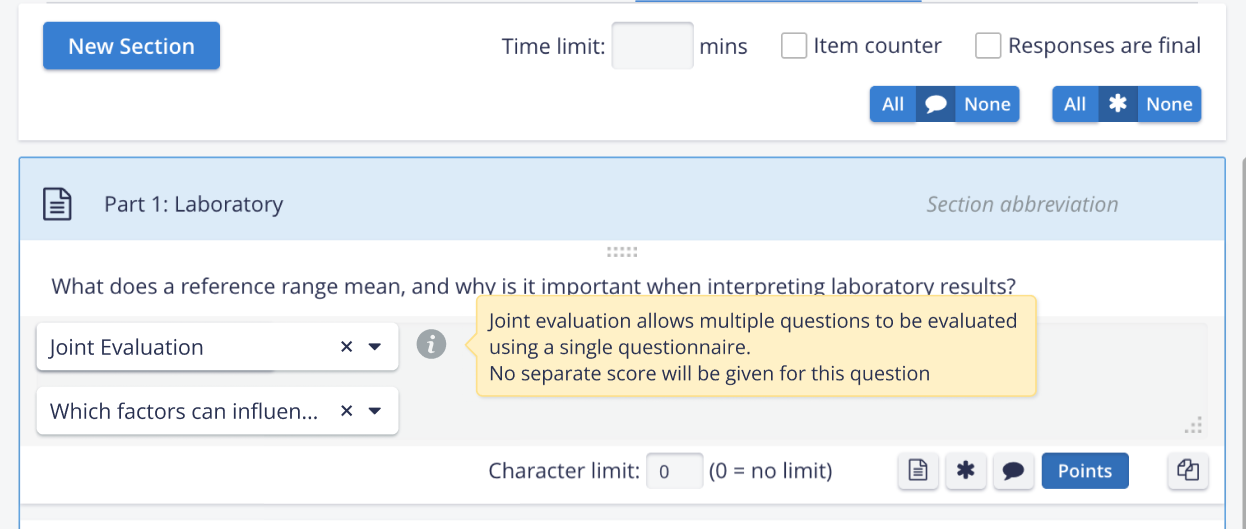
IMPORTANT: A joint item can only select a main question from within the same section; the main question must be located in the same section as the joint item.
REUSE / COPY
Question reuse/copy: If only a joint evaluation question is reused (copied), it will be set to not-scored by default (which can be manually modified if necessary).
Section reuse/copy:
If sections with joint evaluation groups are reused within case parts that allow joint evaluation, the main-joint question relation remains.
If sections with joint evaluation groups are reused within case parts that do not allow joint evaluation, the joint question will be set as not scored.
For details, see How to set up Joint Evaluation and How to use Joint Evaluation.
For further information, visit our Case Manager and Cases - How to pages or watch our Case Manager Training Videos.
Share Scoring Note content for AI
Admin or Case manager users can mark additional scoring content at the question level for AI processing in the OEQS AI Assistant. This way, they can feed additional OEQS scoring-related content to the AI, so the AI's answer suggestions will be based not only on the learner's response but also on the scoring notes.

Share Scoring Notes with AI toggle
For details, go to Items and OEQS Scoring Page